
How to Set Up a Physics Laboratory in a School or College
By Reyami Ventures · 10/31/2026
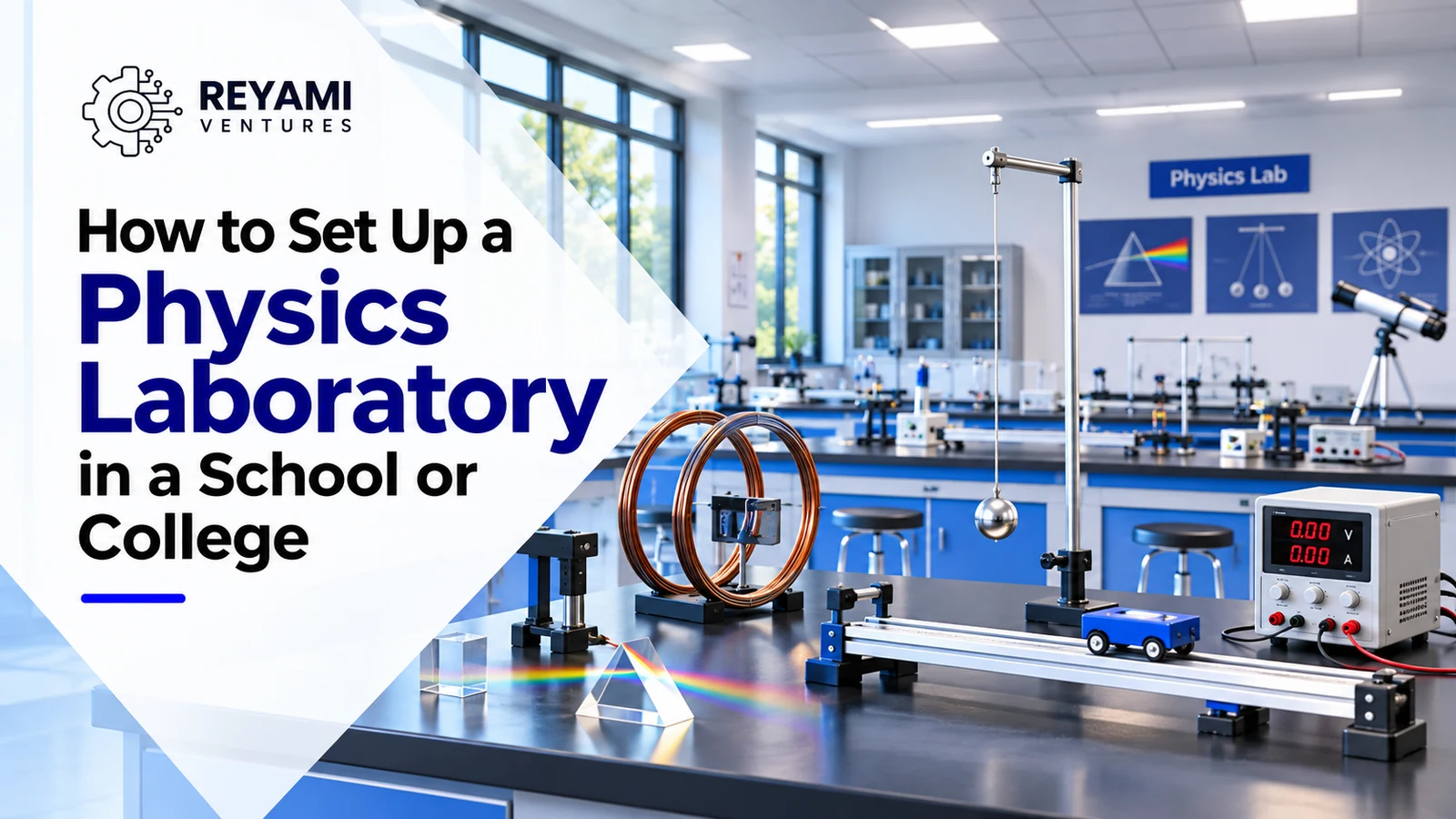
A physics laboratory gives students the opportunity to test scientific principles through measurement, observation and experimentation. Whether the facility is intended for a secondary school, a college or a university department, its design should make practical work safe, organized and repeatable. Students need suitable apparatus, stable work surfaces, accessible services and enough room to carry out experiments under the supervision of teachers and laboratory staff.
A successful physics lab project begins with the academic programme and works outward to the room layout, furniture, equipment, electrical and other services, storage, safety provisions and installation plan. Treating these as connected decisions helps institutions avoid buying equipment that does not fit the room or planning workstations that cannot support the intended experiments.
1. Start With the Practical Curriculum
List the experiments students are expected to perform at each academic level. A school laboratory may focus on foundational topics such as mechanics, heat, light, sound and basic electricity. A college or university may also need facilities for electronics, optics, properties of matter, modern physics or project-based work.
Translate the curriculum into a practical requirement schedule. Record each experiment, apparatus required, number of student groups working at once, setup time, supervision needs and whether the activity requires a dedicated station. This schedule becomes the basis for space planning and equipment procurement.
2. Divide the Room Into Functional Experiment Zones
Different physics experiments have different spatial and service needs. Mechanics activities may need long, level work surfaces. Optics experiments may require controlled lighting and a clear optical path. Electrical and electronics activities need appropriately designed power arrangements and organized component storage.
Where justified, plan distinct zones for mechanics, optics, heat, sound, electricity and electronics, and general demonstrations. Zones can be separate rooms or clearly arranged areas within one room. The final arrangement should reflect room dimensions, class size, teaching methods and risk assessment.
Keep circulation routes clear. Teachers should be able to observe student activity, reach workstations and intervene when necessary. Avoid placing equipment in walkways or creating queues around a single demonstration point.
3. Calculate Workstation Capacity Before Buying Equipment
Workstation numbers should follow the expected class size and teaching model. Decide how many students will share each station, how many groups will work simultaneously and whether demonstrations will take place at a separate instructor bench.
Allow enough usable bench area for apparatus, notebooks and measuring instruments. Consider seating or standing requirements, accessible routes, equipment storage and student movement.
A room that technically accommodates many benches may still be unsuitable if students cannot work comfortably or teachers cannot supervise the class. Check the layout at realistic operating capacity.
4. Choose Laboratory Benches and Furniture for Physics Activities
Physics benches should provide stable work surfaces suitable for measurement and apparatus setup. The furniture specification should consider dimensions, load capacity, surface durability, cable management, storage and the type of experiments performed.
Possible furniture requirements include student workbenches, instructor demonstration benches, instrument tables, component cabinets, apparatus racks, lockable storage and mobile trolleys. Electronics or precision measurement stations may need different arrangements from general-purpose experiment benches.
Select modular furniture where it supports future changes, but confirm that it remains stable and appropriate for the equipment. Plan storage so delicate apparatus is protected and frequently used items are easy to issue and return.
5. Build an Equipment Schedule Around Experiments
Do not use a generic equipment list as the only basis for procurement. Match each item to a defined experiment, student capacity and academic level. Specify quantities, accessories, measurement ranges, power requirements, software needs where applicable and any calibration or service expectations.
Depending on the curriculum, a physics laboratory may require optical benches, lenses, mirrors, prisms, spectrometers, vernier calipers, screw gauges, balances, pendulum apparatus, spring and force equipment, thermal experiment kits, electrical meters, power supplies, resistors, circuit components and electronics trainers.
Confirm compatibility between equipment and accessories. A measurement instrument should have the required range and resolution for the experiment, while an electrical trainer should suit the intended student activities and supervision arrangements.
6. Coordinate Electrical and Other Building Services
Electrical planning is particularly important for physics laboratories. Identify equipment that needs mains power, low-voltage supplies, dedicated circuits, data connections or other services. Record the location and specification of each connection before furniture and equipment positions are finalized.
Plan cable routing to reduce trip hazards and accidental disconnection. Electrical installations, protective devices, earthing and testing must be designed and verified by qualified professionals in accordance with applicable requirements.
Some activities may also need controlled lighting, ventilation, water or other building services. Identify these needs from the experiment schedule rather than assuming every physics lab has the same requirements.
7. Make Safety Part of the Layout
Safety provisions should reflect the actual experiments and equipment. Review electrical risks, hot surfaces, moving apparatus, glass components, lasers or optical sources where used, trip hazards and manual handling. Arrange a suitable risk assessment before the laboratory is commissioned.
Consider emergency isolation of electrical supplies where appropriate, clear access to exits, suitable fire protection, first-aid arrangements, warning signs, equipment instructions and safe storage. Specialist hazards require controls appropriate to the equipment and its use.
Establish procedures for equipment issue, inspection, experiment supervision, reporting faults and returning apparatus to storage. Students should receive safety instruction before practical sessions.
8. Plan Storage, Preparation and Equipment Care
Provide defined storage for apparatus, cables, electronic components, optical accessories, measuring instruments and consumables. Delicate or precision equipment may need protective cases, controlled storage conditions or restricted access.
Allow staff space to prepare experiments, check apparatus and organize materials before classes. An issue-and-return process can reduce missing components and make practical sessions more efficient.
Create an inventory recording equipment identification, location, condition, purchase details, manuals and service information. Establish inspection and maintenance routines based on manufacturer guidance and institutional procedures.
9. Include Installation, Testing and Faculty Orientation
Before delivery, verify that the room, furniture, electrical services and access routes are ready. Check door widths, movement paths, bench dimensions, power points and any special environmental requirements.
Installation should be followed by checks and functional tests appropriate to the supplied equipment. Confirm that accessories are present, equipment is placed correctly and required service connections have been completed by competent personnel.
Provide faculty and laboratory technicians with operating instructions, manuals, warranty details, maintenance guidance and relevant training. Record incomplete work and agree how it will be closed before final handover.
10. Plan the Project as One Coordinated Scope
A complete educational physics laboratory may involve requirement assessment, layout planning, laboratory furniture, equipment supply, building-service coordination, installation, commissioning, training and handover. When activities are split across vendors, responsibilities and interface points should be clearly documented.
Prepare a project brief stating room details, academic requirements, student capacity, equipment expectations, utility responsibilities, safety review, project sequence, acceptance criteria and support expectations. This gives the institution and project partners a common basis for decisions.
Revisit the brief when the curriculum or room conditions change. A documented scope makes it easier to evaluate proposals on suitability and completeness rather than comparing only item counts or headline price.
Physics Laboratory Setup Checklist
- Curriculum topics and practical experiments are listed.
- Student capacity, group size and supervision model are confirmed.
- Experiment zones and circulation routes are planned.
- Workstation dimensions and furniture specifications are documented.
- Equipment quantities and specifications are mapped to experiments.
- Electrical loads, outlets, cable routing and protective provisions are reviewed by qualified professionals.
- Lighting, ventilation and other service requirements are identified where relevant.
- Risk assessment, signage, emergency arrangements and operating procedures are planned.
- Storage, preparation and equipment inventory arrangements are defined.
- Delivery access, installation, testing, training and handover are included in the project scope.
Conclusion
A well-planned physics laboratory connects the curriculum to the physical environment in which students learn. Start with the experiments, determine the number and type of workstations, select equipment against clear specifications, and coordinate furniture, electrical services, safety, storage and installation as one project.
For schools, colleges and universities planning a new facility or upgrading an existing one, Reyami Ventures can be considered for laboratory planning, infrastructure and furniture, equipment coordination, installation and commissioning. A useful first step is to prepare the room dimensions, intended experiments, student capacity and any existing equipment inventory.
Related Pages
Turnkey laboratory projects and planning
Frequently asked questions
It should include workstations, apparatus and measuring instruments matched to the curriculum, suitable storage, required services and safety arrangements. The exact list depends on the experiments and student capacity.
Requirements vary by course and level. They may include apparatus for mechanics, optics, heat, electricity, electronics and measurement. Build the list from the approved practical syllabus.
Use the experiment schedule to identify activities with different space, lighting, power or safety needs. Arrange suitable zones while preserving circulation and teacher supervision.
Many experiments use powered instruments, low-voltage supplies or electronic trainers. Electrical requirements and cable routes should be coordinated with the room and furniture layout and reviewed by qualified professionals.
Choose stable benches and storage based on apparatus dimensions, loads, work surfaces, cable management and the activities being performed.
It may be possible if the room has suitable space, equipment, storage and services. Some experiments may need dedicated zones or separate rooms, depending on their requirements.
A defined turnkey scope may cover requirement assessment, planning, furniture and infrastructure, equipment supply, coordination of services, installation, commissioning, training and handover. Confirm inclusions and responsibilities in writing.
Involve the partner while the institution is defining requirements and planning the room. Early coordination can align furniture, equipment, utilities and installation needs before construction decisions are fixed.