
How Should You Choose Laboratory Equipment for a New or Growing Facility?
By Reyami Ventures · 10/3/2026
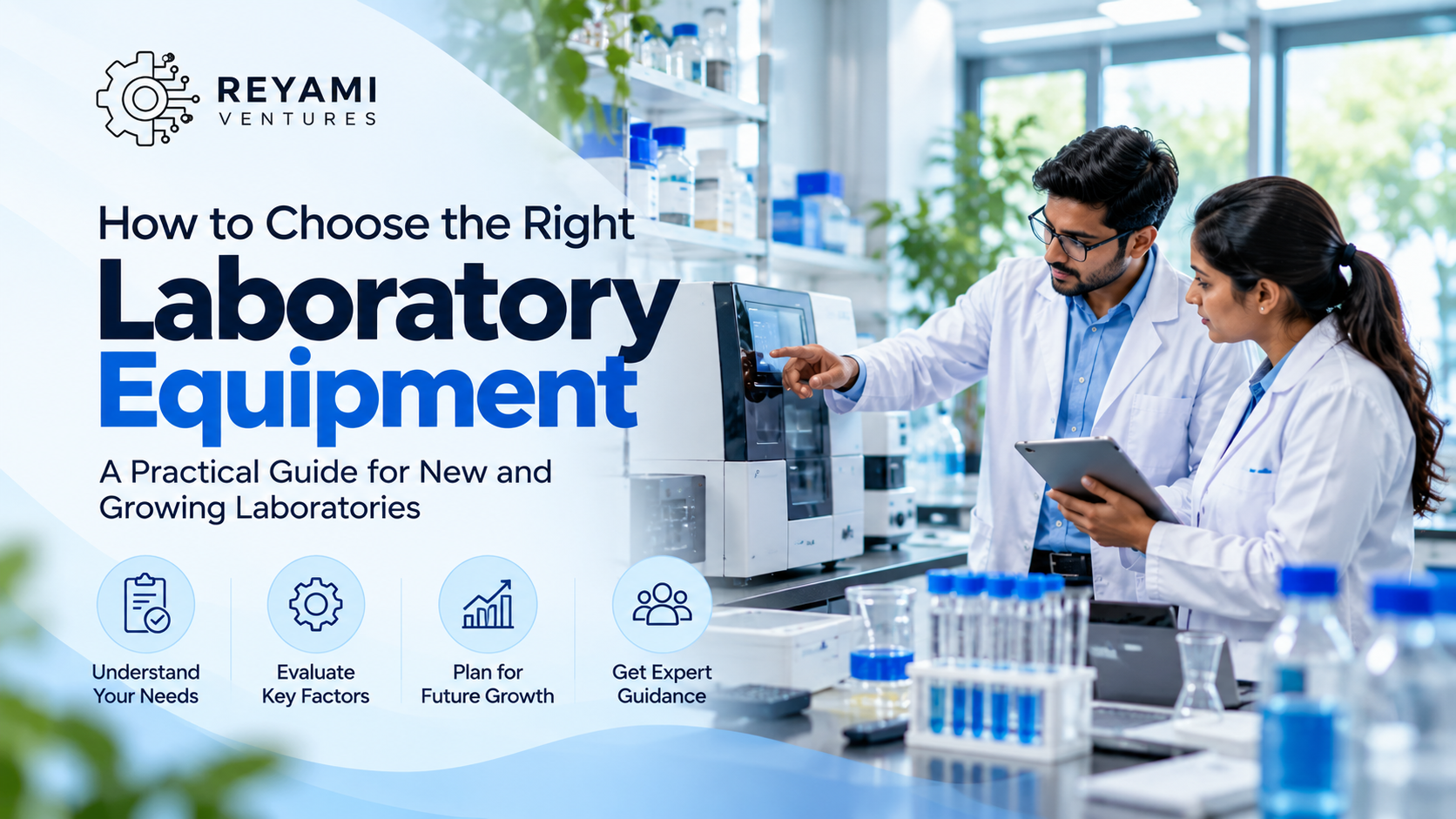
Buying laboratory equipment can look like a straightforward procurement exercise. Find the required instrument, compare a few models, check the specifications and place the order. That approach works for some routine purchases, but it becomes much less useful when the equipment is part of a new laboratory, a major upgrade or a growing facility.
The reason is simple: laboratory equipment does not work by itself. It depends on the application, the people using it, the available infrastructure, supporting accessories, consumables, maintenance and the way work moves through the laboratory.
So instead of starting with the question, 'Which machine should we buy?', it is often better to start with a few more practical questions.
1. What is the laboratory actually expected to do?
This is the first question because equipment should follow the work. A laboratory designed for routine testing may have very different requirements from one intended for research, teaching, quality control, diagnostics or forensic applications.
Define the main activities first. What will be tested or processed? How frequently? Who will operate the equipment? What level of output is expected? Are there particular environmental or safety requirements?
Once these points are clear, equipment selection becomes more focused. You are no longer comparing products simply because they appear in the same category. You are comparing them against an actual requirement.
2. Should specifications be the main deciding factor?
Specifications matter, but they should not be the only deciding factor. A long specification sheet can make one product look better on paper while saying very little about whether it is the right fit for a particular laboratory.
Look at the specifications that affect the intended application. Then consider usability, installation requirements, operating conditions, maintenance access, supporting accessories and compatibility with the rest of the setup.
The practical question is: will the equipment perform the required job reliably in the environment where it will actually be used?
3. How much equipment does a laboratory really need?
More equipment does not automatically mean a better laboratory. Buying instruments that are rarely used can tie up capital, occupy valuable space and create additional maintenance requirements.
A better approach is to separate essential equipment from supporting equipment and future requirements. Start with what is necessary for current operations. Then identify what improves efficiency or safety. Finally, consider what may be required if the workload or scope increases.
This creates a procurement plan that is easier to justify and easier to expand later.
4. How does the laboratory layout affect equipment selection?
Equipment should be evaluated with its physical environment in mind. Dimensions are only the beginning. Consider operating clearance, access for staff, service access, electrical connections, ventilation, water or drainage requirements where applicable, and the movement of materials around the instrument.
A common mistake is to confirm that a machine can physically fit into a room and stop there. The more useful question is whether people can comfortably work around it and whether technicians can access it when maintenance is required.
This is particularly important in compact laboratories, where one poorly positioned instrument can affect several workstations.
5. What supporting equipment and accessories should be considered?
The main instrument is often only one part of the requirement. Depending on the application, supporting equipment, accessories, storage systems or other components may be needed for the workflow to operate properly.
Before finalizing a purchase, ask what is required for installation, operation and routine use. This prevents the situation where the main equipment arrives but the laboratory is still unable to use it because a supporting component was not considered.
6. Where do laboratory consumables fit into procurement planning?
Consumables deserve their own place in the planning process because they affect day-to-day continuity. A laboratory may have all its major instruments installed and still face delays if essential consumables are not available when needed.
Think about expected usage, storage conditions, replenishment frequency and the consequences of running out. It is also useful to understand which supplies are routine and which may have application-specific requirements.
This is why a complete procurement discussion should not stop at the equipment list. The operating environment matters just as much as the initial purchase.
7. How important is after-sales support when choosing laboratory equipment?
Support becomes more important as equipment becomes more specialized or operationally critical. Installation, troubleshooting, preventive maintenance, calibration requirements and access to technical assistance can all affect the long-term usefulness of an instrument.
Before buying, ask what happens after delivery. Who will assist with installation? How are service requirements handled? What is the process if the equipment stops working? Are users provided with the information they need to operate it correctly?
The answers can be just as important as the initial specification comparison.
8. Should price be the deciding factor?
Price is obviously part of procurement, but it should be viewed alongside the total requirement. A lower purchase price does not necessarily mean a lower overall cost if the equipment requires significant supporting infrastructure, frequent servicing or additional components that were not considered initially.
At the same time, paying more is not automatically better. The useful comparison is between the actual requirement and the value the equipment is expected to provide over its working life.
A clear requirement makes this comparison much easier because it gives the procurement team a practical basis for deciding what matters and what does not.
9. How can organizations avoid buying equipment they do not really need?
Start with usage rather than features. Ask how often the equipment will be used, by whom, for what applications and at what expected workload.
If a feature does not contribute meaningfully to the intended application, it should not become the reason for choosing a particular model. This does not mean choosing the most basic option. It means paying attention to the requirements that actually affect the work.
A written requirement sheet can be surprisingly useful here. It creates a reference point that keeps the procurement discussion focused.
10. What changes when a laboratory is being expanded?
Expansion introduces another layer of planning. Existing equipment, available space, utilities and workflow all have to be considered alongside the new requirement.
Before adding equipment, check whether the current infrastructure can support it. Also consider whether the new instrument will create bottlenecks in storage, movement or maintenance.
If the laboratory is likely to continue growing, it can be useful to leave practical flexibility in the layout and utility planning rather than treating every new purchase as a completely separate project.
11. What should be documented before procurement begins?
A basic procurement document can include the application, expected workload, essential specifications, infrastructure requirements, accessories, consumables, installation requirements and support expectations.
The purpose is not to create a complicated document. It is to make the requirement clear enough that different options can be compared on the same basis.
This also reduces the chance of important requirements being remembered verbally but missed during the final purchase process.
12. When does a complete laboratory solution make more sense than individual purchases?
Individual purchasing can work well when an established laboratory needs a specific replacement or addition. A more coordinated solution can be useful when a facility is being built from the ground up, substantially upgraded or designed around a defined workflow.
In those situations, layout, equipment, supporting requirements, consumables and operational needs are connected. Planning them together can reduce the risk of solving one problem while creating another.
For equipment categories and related products, explore Reyami Ventures' laboratory product range
13. What should you ask before finalizing a laboratory equipment purchase?
- Does the equipment match the actual application and expected workload?
- What infrastructure is required for installation and operation?
- What accessories or supporting equipment are needed?
- What consumables will be required for routine use?
- How much space is needed for operation and maintenance?
- What technical support is available after installation?
- How will the equipment fit into the existing or planned workflow?
- Can the setup accommodate realistic future expansion?
14. What is the biggest procurement mistake to avoid?
The biggest practical mistake is treating laboratory equipment as an isolated purchase. An instrument can be technically suitable and still be a poor fit for the laboratory if the workflow, infrastructure, support or operating requirements were not considered.
The better approach is to look at the equipment as one part of a larger system. Once that mindset is adopted, procurement becomes less about finding a product that looks good on paper and more about finding a solution that works in practice.
How to Start a Laboratory Equipment Discussion with Reyami Ventures
If you are still at the planning stage, you do not need to have every equipment model decided before starting a conversation. A useful first discussion can begin with the laboratory type, intended application, available space, expected workload and the outcome you are trying to achieve.
From there, equipment and supporting requirements can be evaluated against the actual project rather than selected in isolation.
Explore Reyami Ventures laboratory solutions
Final Takeaway
Good laboratory procurement is not simply about finding an instrument with an impressive specification sheet. It is about making sure the equipment fits the application, the workflow, the infrastructure, the people using it and the future direction of the facility.
The more clearly those requirements are defined before procurement, the easier it becomes to compare options, control unnecessary spending and build a laboratory that works beyond the day of installation.
Frequently asked questions
Start with the intended application, workload, users and infrastructure. Then compare equipment against those requirements rather than comparing specifications alone.
Consider installation requirements, usability, space, maintenance access, accessories, consumables, technical support and compatibility with the laboratory workflow.
Not necessarily. Compare the purchase price with the complete requirement, including supporting infrastructure, accessories, maintenance and expected use.
Consumables support routine operation. Planning them early helps avoid interruptions and ensures that storage and replenishment are considered.
Yes. Equipment dimensions, clearances, utilities, staff movement and service access can all affect the layout.
Installation, user guidance, maintenance, technical support and appropriate documentation are all part of keeping equipment useful over time.
Reyami Ventures presents both laboratory products and broader solution-oriented offerings. Project requirements should be discussed based on the specific application and facility.
Useful information includes the laboratory type, intended applications, available space, expected workload, known equipment requirements and infrastructure constraints.