
How to Plan an Electronics and Instrumentation Laboratory for an Engineering College
By Reyami Ventures · 11/3/2026
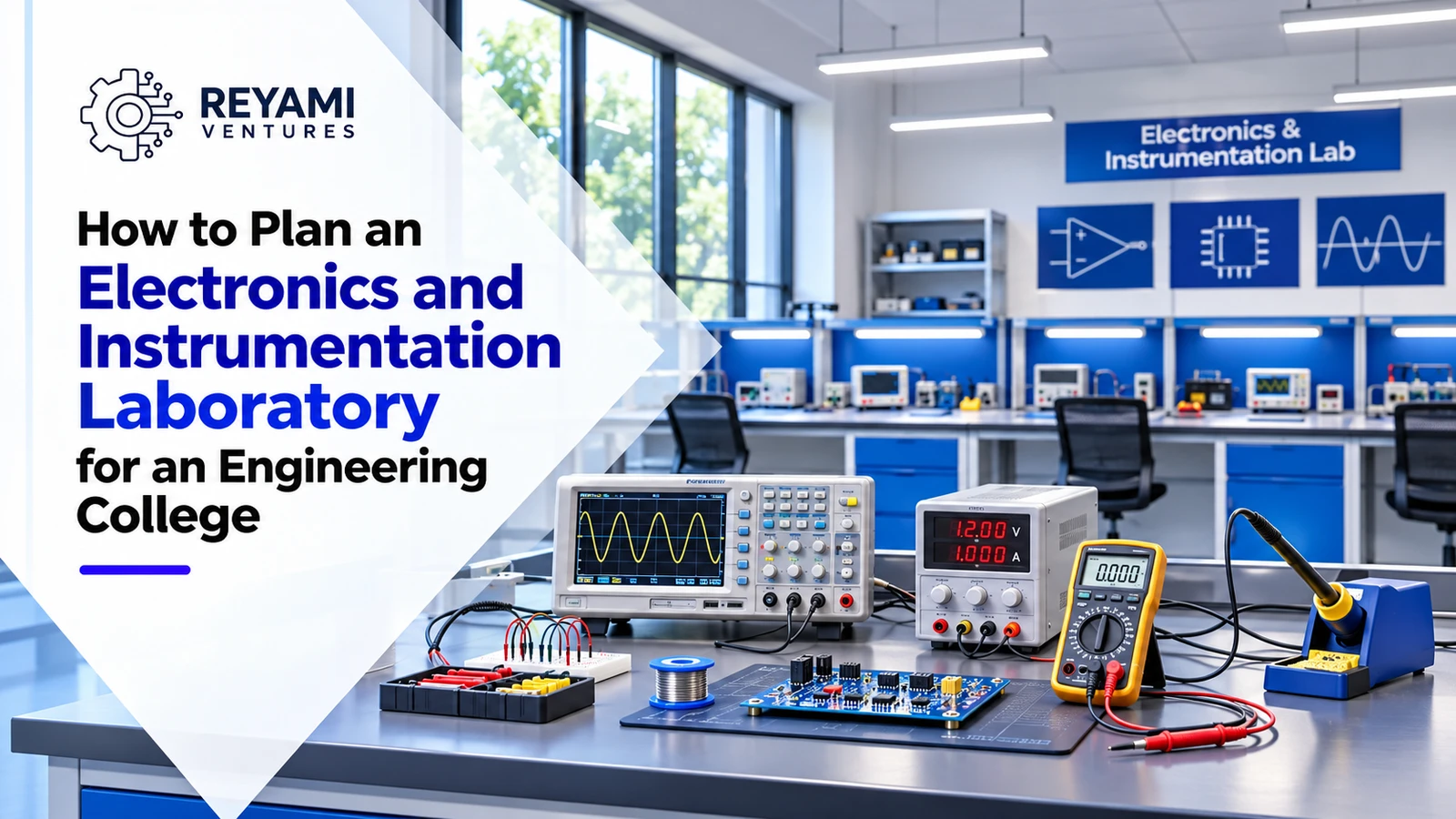
An electronics and instrumentation laboratory is where engineering concepts become measurable, testable systems. Students use it to assemble circuits, observe signals, measure electrical quantities, understand sensors and study how instruments interact with real processes. The quality of this learning environment depends on more than the number of instruments purchased. Its layout, electrical infrastructure, safety provisions, storage and teaching workflow must work together.
For an engineering college planning a new facility or upgrading an existing one, the first step is to define the practical activities the laboratory must support. Equipment should follow the curriculum and intended experiments, not the other way around.
1. Begin with the curriculum and practical outcomes
List the courses, semester-wise experiments and project activities that will use the laboratory. An introductory electronics course may require basic circuit assembly and measurement. An instrumentation course may involve sensors, transducers, signal conditioning, calibration and data acquisition. Advanced classes may need microcontroller interfaces, communication modules or process-control demonstrations.
Convert each activity into an equipment and infrastructure requirement. Record the number of student groups working at the same time, the expected class size, the number of stations and whether experiments are individual or team-based. This creates a defensible basis for the equipment schedule and helps avoid both under-provisioning and unnecessary purchases.
2. Organise the laboratory into functional zones
A practical layout separates activities that have different space, power and supervision needs. The exact arrangement will depend on room dimensions, class size and the institution's teaching plan.
3. Select instruments around the experiments
The equipment list should be mapped to the learning outcomes and required measurement ranges. Typical categories for an electronics and instrumentation teaching laboratory may include:
- Basic measurement: digital multimeters, bench power supplies, test leads and continuity-testing accessories.
- Signal observation and generation: oscilloscopes, function or signal generators, probes and connection accessories.
- Circuit experimentation: breadboards, electronic component kits, trainer boards and soldering equipment.
- Instrumentation learning: sensor and transducer demonstration kits, signal-conditioning modules and calibration setups.
- Digital electronics: logic trainers, digital IC kits and relevant interface modules.
- Data acquisition and control: data acquisition hardware, interface modules or process-control trainers where the curriculum requires them.
These are planning categories, not a universal purchase list. Instrument specifications, quantities, accuracy, bandwidth, voltage and current ranges, connectivity and accessories should be confirmed against the experiments and institutional technical requirements.
4. Plan electrical infrastructure before installing equipment
Electrical planning is a core part of laboratory design. Determine the number and location of outlets, circuit loading, distribution arrangement, earthing, protective devices and emergency isolation requirements with qualified electrical professionals. Avoid relying on extension boards as a substitute for properly designed bench power.
Keep power and signal cables organised and reduce trip hazards. Provide clear identification for supplies and isolation points. Where equipment has specific power-quality, grounding or environmental requirements, include them in the layout and installation plan before procurement is finalised.
5. Build safety into the workstation design
Students may work with exposed conductors, powered circuits, heated soldering tools and electronic components. Establish operating procedures for energising circuits, checking connections, handling hot tools and reporting damaged equipment. Provide appropriate first-aid and emergency arrangements, accessible isolation and suitable fire-safety provisions as determined by the institution's risk assessment and applicable requirements.
Soldering should take place only in a designated, supervised area with appropriate ventilation and safe storage. Keep liquids away from electrical workstations. Use suitable personal protective equipment where the activity requires it, and ensure students receive a safety briefing before practical sessions.
6. Choose benches, furniture and storage for daily use
Laboratory furniture should support the actual working posture and equipment footprint. Consider bench depth, load capacity, surface durability, cable access, under-bench storage and the ability to reconfigure stations. A crowded bench makes it harder to observe readings, trace connections and keep components organised.
Use labelled storage for components by type and value, and maintain separate locations for tools, consumables, student kits and instruments awaiting repair. A simple issue-and-return process can reduce losses and help teaching staff prepare each practical session.
7. Provide a reliable system for calibration and maintenance
Measurement instruments need periodic checks and, where required by their intended use, calibration at defined intervals. Maintain an asset register with equipment identification, model, serial number, location, purchase details, warranty, service history and next calibration or inspection date. Keep damaged or unreliable instruments out of student use until they have been assessed.
Plan for routine inspection of leads, probes, power cords, connectors and soldering tools. Include consumables and commonly needed spares in the operating plan so that a missing accessory does not repeatedly interrupt practical classes.
8. Coordinate procurement, installation and commissioning
A laboratory project involves more than delivering instruments. The room, furniture, electrical services, equipment, accessories and teaching requirements must be coordinated. Before installation, confirm room readiness, utility points, access routes, delivery constraints and the final equipment schedule.
During commissioning, verify that equipment is installed in the intended location, powers on correctly, includes the specified accessories and is suitable for the planned demonstrations. Record serial numbers and warranty details, collect manuals and service information, and train the responsible faculty or laboratory staff on operation and basic care.
9. Prepare for future courses and student projects
Engineering programmes evolve. A laboratory should have a realistic allowance for additional workstations, new trainer modules, project development and equipment upgrades. Modular furniture and clearly documented utility points can make future changes easier. Plan expansion based on likely curriculum changes and actual utilisation rather than buying equipment that may remain unused.
Functional layout: areas to consider
- Student workstations: benches with suitable work surfaces, accessible power, seating and room for instruments and notebooks.
- Demonstration area: a visible instructor station, display or projection facility and space for live demonstrations.
- Testing and measurement area: dedicated locations for shared or higher-value instruments, with controlled access and cable management.
- Assembly and soldering area: a supervised section with ventilation, heat-resistant surfaces and safe tool storage.
- Component and tool storage: labelled cabinets and bins for components, probes, leads, kits and spare parts.
- Project area: flexible bench space for student projects, fault-finding and longer practical activities.
Planning checklist
- Map every proposed instrument to a course, experiment or project outcome.
- Confirm class size, student group size and simultaneous workstation requirement.
- Prepare a scaled layout with teaching, testing, assembly and storage zones.
- Finalise power, earthing, protection and emergency isolation requirements.
- Specify benches, seating, storage and cable-management provisions.
- Define safety procedures for electrical work and soldering activities.
- Confirm instrument specifications, accessories, quantities and support requirements.
- Create an asset register and maintenance or calibration schedule.
- Plan delivery, installation, commissioning, documentation and staff training.
Plan the laboratory as one coordinated project
An effective electronics and instrumentation laboratory brings together curriculum requirements, functional layout, suitable equipment, dependable utilities, safe workstations and a practical maintenance plan. Treating these elements as one coordinated project helps institutions create a facility that supports hands-on learning from the first practical session and remains useful as programmes develop.
Reyami Ventures supports laboratory planning, infrastructure and equipment requirements for educational and institutional facilities. Institutions planning a new engineering laboratory or upgrading an existing one can begin by defining their room, curriculum, capacity and equipment requirements, then coordinating the project scope around those needs.
Related pages
Explore [laboratory solutions and turnkey projects](/solutions), the [equipment catalogue](/equipment), [industries served](/industries) and [project experience](/projects), or [contact Reyami Ventures](/contact) to discuss your laboratory.
Frequently asked questions
It gives students practical experience in circuit assembly, electrical measurement, signal analysis, sensors, transducers, calibration and related instrumentation concepts.
Depending on the curriculum, common categories include digital multimeters, bench power supplies, oscilloscopes, signal generators, trainer kits, probes and component kits.
Plan separate or clearly defined areas for student workstations, instructor demonstrations, testing, soldering, component storage and project work. The final layout should reflect room size and class workflow.
A correctly designed earthing and protection arrangement is an important part of electrical safety and reliable equipment operation. It should be designed and verified by qualified professionals.
That depends on class size, experiment type, timetable and budget. Calculate the number of simultaneous groups and ensure each group has sufficient bench space and access to the required instruments.
Commissioning should verify installation, operation, accessories, documentation, asset details, warranty information and staff familiarisation against the approved specifications.
Yes. An upgrade can be prioritised around safety gaps, curriculum needs, unreliable equipment, workstation capacity and infrastructure constraints. A condition assessment should guide the sequence.